
Now that Google has officially announced plans to incorporate machine learning into AdWords, artificial intelligence (AI) will soon make its way into all of Google’s search-related products. In fact, it’s already starting to happen!
When our Senior VP of Technology, GP, heard about Google’s impending machine learning updates, he wanted to check out the validity of these claims for himself. He discovered that Google is already using AI to automatically categorize local businesses.
How We Tested This Ourselves
GP conducted three related Google searches to see what was happening behind the scenes in the source code:

He found that all searches (“burger in McKinney,” “restaurant in McKinney,” and “fast food in McKinney”) surfaced an unusual keyword in the code: “fast food container in McKinney.” Furthermore, searching for “fast food container in McKinney” returned fast food restaurants rather than businesses commercializing containers. Google seems to be creating keywords for categories, as displayed in the screenshot below.
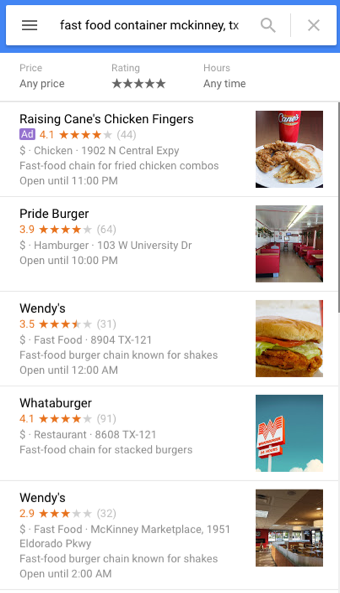
So how do these results demonstrate machine learning at work?
Consider this: why else would restaurants show up in a search for fast food containers? And why would such an uncommon phrase appear in the source code when we searched for “burger in McKinney?”
Most fast-food chain owners wouldn’t think of “container” as a keyword their customers might search for. Advice Local’s discovery implies that Google is automatically assigning these categories — using machine learning — rather than the business owner.
AI Will Teach Google to Understand Predictive User Intent
In our last article, we talked about how machine learning will help Google accurately target consumers based on intent and learn when to ignore, add or change function words. However, AI takes this process a step further by teaching Google to draw bigger conclusions from search context.
For example, a simple search for “hotels in McKinney” tips Google off to the fact that you’ll be visiting the area. Artificial intelligence allows Google to make the connection that since you’re booking a hotel in McKinney, you may also need a flight to the area. Soon you’ll see ads for upcoming flights and airlines that fly into Dallas, even though you haven’t searched for “flights to Dallas” quite yet.
Google’s automated categorization of businesses is part of this process. The search engine is essentially teaching itself how to better predict what consumers are looking for. The algorithm will allow Google to refine search results and targeted ads to the point of anticipating consumer needs before they even search for them.
Keeping Local Businesses Up-to-Date in the Ever-Changing World of Local Search
Advice Local’s technology team makes a point of maintaining leadership in everything related to local search. We’re constantly on the lookout for changes like this so we can inform our partners and clients about the latest updates in the world of local search.
Contact us today to discover how our expertise can help you and your clients dominate local search!